


If your business has entities in Europe, e-invoicing has become a system requirement. Belgium and Poland went mandatory at the start of this year. France switches on in September 2026. Germany and Spain follow in 2027, and the EU-wide ViDA package makes structured e-invoicing and digital reporting compulsory for cross-border B2B trade from July 2030.
For finance teams on older or heavily customised systems, each new mandate tends to mean another connector, another spreadsheet reconciliation, or another local tool that nobody in head office can see into. It is one of the more common reasons to look at a NetSuite migration.
What E-Invoicing Means in Practice
For the new Europe mandates, a PDF attached to an email is not an e-invoice. Regulators require a structured data file, usually XML built on the European EN 16931 standard, that a machine can read, validate, and post without a person re-keying anything.
The countries differ in what happens to that file. In Poland and Italy, the invoice is submitted to a government platform, which validates it and assigns a registration number before it counts as issued under the local rules. In Belgium, it travels supplier-to-customer over the Peppol network, with tax authority reporting layered on later. In Germany, there is no central platform at all; the structured file simply must be issued and received in an approved format. France has built its own model around accredited private platforms.
This matters because the mechanism dictates what your ERP needs to do. A clearance model needs a live connection to a tax authority API and a way to hold the invoice until the registration number comes back. A network model needs an access point. A format-only model needs a correct XML and a delivery method the customer will accept. One configuration does not fit all three.
Which EU Countries Have Mandatory E-Invoicing
As of August 2026, this is the position of six European countries.
| Country | Status | Model and format | Key dates |
|---|---|---|---|
| Italy | Live |
Clearance via SDI, FatturaPA XML |
Mandatory for B2B and B2G since 2019 |
| Belgium | Live |
Peppol network, Peppol BIS 3.0 (UBL 2.1) |
Mandatory from 1 January 2026; tolerance period ended 31 March 2026; e-reporting to the tax authority planned for 2028, legislation not yet passed |
| Poland | Live |
Clearance via KSeF, FA(3) XML |
Receiving mandatory for all from 1 February 2026; issuing from 1 April 2026 for most - businesses; businesses invoicing PLN 10,000 gross or less per month exempt until end of 2026; penalties apply from 1 January 2027 |
| France | Imminent | Accredited platforms (PA, formerly PDP); Factur-X, UBL 2.1, or CII | All businesses must be able to receive from 1 September 2026; large and mid-sized must issue from the same date; all others issue from 1 September 2027 |
| Germany | Phasing in |
No central platform; XRechnung or ZUGFeRD 2.1+ |
Receipt mandatory since 1 January 2025; transitional right to issue paper or PDF ends 31 December 2026 for businesses with prior-year turnover above €800k, and 31 December 2027 for everyone else |
| Spain | Phasing in | Two separate regimes: Veri*Factu (certified invoicing software) and mandatory B2B e-invoicing under Crea y Crece (Royal Decree 238/2026) | Veri*Factu from 1 January 2027 (corporate taxpayers) and 1 July 2027 (others). B2B e-invoicing regulation published 31 March 2026; obligations start 12 months after the pending ministerial order for businesses above €8m turnover and 24 months for the rest. The draft order targets 1 October 2026, which would put larger businesses in scope from October 2027 |
Two points worth drawing out:
First, Poland is further along than most people assume. The obligation to issue through KSeF has applied to most VAT-registered Polish businesses since April 2026, with only the smallest invoicers exempt until the end of the year. What remains is the end of the grace period on 1 January 2027, after which invoices issued outside KSeF can attract penalties of up to 100 percent of the VAT shown. If you have a Polish subsidiary still emailing PDFs, that is not a 2027 problem. Note that the issuing obligation applies to entities established in Poland; a UK company with no Polish establishment invoicing Polish customers is outside it, although the customer will still want to receive through KSeF. You can read more about it in our dedicated article.
Second, Germany’s receiving obligation is already two years old. A German entity that cannot ingest an XRechnung file today is technically non-compliant, even though the issuing obligation is still some months away.
Where ViDA Fits
The EU’s VAT in the Digital Age package was formally adopted on 11 March 2025. Its most significant effect for finance teams is that from 1 July 2030, cross-border B2B transactions within the EU become subject to mandatory e-invoicing and near-real-time digital reporting to tax authorities, based on the EN 16931 standard.
ViDA also removed the requirement for member states to seek EU approval before mandating domestic e-invoicing, which is why the national timelines above have accelerated rather than converged. We can expect more of them. The Netherlands and Ireland have already published phased plans that land around the 2030 deadline.
At this point, any e-invoicing design you put in place should assume it will be extended, not replaced, over the next four years.
What NetSuite Covers Natively
NetSuite’s e-invoicing capability is built on the Electronic Invoicing SuiteApp, which provides the general framework for generating, sending, receiving, and certifying e-documents, plus country-specific SuiteApps that sit on top of it. For the EU, the relevant one is the European Union Electronic Invoicing SuiteApp.
When simplified, NetSuite native e-invoicing feature is built on three layers:
- Oracle’s own SuiteApps, installed from the NetSuite SuiteApp Marketplace and maintained by Oracle, not partner-built localisation packages
- The underlying Electronic Invoicing SuiteApp, which is free for one country per account. Generating e-documents for more than one country requires a licence from Oracle, which for a group with three or four European entities is an additional budget line.
- The EU SuiteApp, which requires a OneWorld account and sits on top of four other Oracle SuiteApps, so the installation is a small stack rather than a single switch.
Oracle lists the following country coverage for that EU SuiteApp:
- Belgium: inbound and outbound invoices, credit memos, vendor bills and vendor credits over Peppol
- Denmark: inbound and outbound, as for Belgium, over Peppol
- France: sending, receiving and processing of inbound and outbound transactions
- Germany: receiving and processing of inbound vendor bills in XRechnung format
- Poland: outbound invoices and credit memos through KSeF
- Spain: outbound invoices and credit memos through Veri*Factu
Italy is handled separately through the Italy Localization SuiteApp, which has supported SDI for several years.
Read that list carefully, because the direction of travel matters. Germany is inbound only, which covers the obligation that is live today but not the issuing obligation arriving in January 2027. Poland is outbound-only, so purchase invoices retrieved from KSeF require an additional route into NetSuite. Spain covers Veri*Factu but not yet the separate B2B exchange under Crea y Crece, for which the Spanish authorities have still to finalise the technical order. Oracle also lists known limitations, including that invoice cancellation is not currently supported for Spain and that tax mapping is not supported from inbound XML in Belgium.
None of this means you shouldn’t choose NetSuite. Oracle has shipped support for each mandate broadly in step with the mandate itself, and the framework is designed to be extended. It does mean, though, that “NetSuite supports e-invoicing” is a statement that needs a country and a direction attached before it tells you anything useful.
How the Flow Works Inside NetSuite
For outbound documents, NetSuite generates a structured e-document from the transaction record, applies the country template, and routes it through the configured sending method. Depending on the country, that might be a Peppol access point, a direct tax authority connection, or a certified platform. Where the regime requires clearance, the registration number or rejection message comes back and is recorded against the original transaction.
For inbound documents, structured files arrive from the network or platform, get converted into vendor bills or vendor credits, and land in the normal AP approval flow. From there, matching and approval follow whatever process the entity already runs for vendor bills.
The Electronic Documents Dashboard shows what is pending generation, sending, certification, or in error, and shows a rejection reason such as an invalid VAT number. Timestamps, status changes, and payloads are retained alongside the record, which is what makes the audit trail defensible.
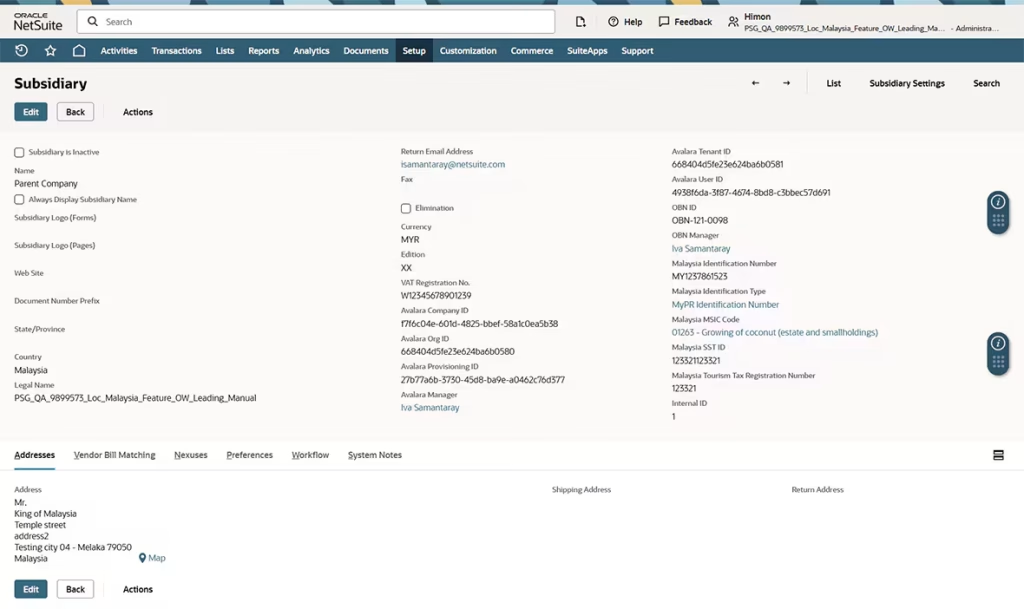
One configuration detail that catches multi-entity groups out: templates and sending methods are assigned per subsidiary, and clearance regimes such as KSeF authenticate the Polish entity specifically. A OneWorld account with Polish, Belgian, and French entities is three configurations sharing one framework, not one configuration applied three times.
Where You Need a NetSuite Partner
The SuiteApps handle format and transmission. They do not decide the things that determine whether the project succeeds. For that, you need experts to understand the requirements and set up your system accordingly.
Scoping. Which entities are in scope for which mandate, and from when, is a legal question before it is a technical one. A UK group with a Belgian sales office and a German holding company has two different obligations with two different start dates, and the answer changes if either entity is below a turnover threshold.
Data readiness. Clearance regimes reject invoices with missing or malformed fields. The Polish FA(3) schema requires data that NetSuite does not populate by default, such as a buyer’s purchase order reference where the contract requires one. Finding these gaps in testing is cheap. Finding them on 1 January 2027 is not.
Filling the gaps in coverage. For German outbound, Polish inbound, and the Spanish Crea y Crece B2B flow, you will need either a third-party connector or a customised extension of the Electronic Invoicing framework unless and until Oracle adds native support. Choosing an option that will not need replacing in eighteen months takes some judgement.
Process design. Under KSeF, the buyer retrieves invoices from the platform rather than receiving them from the supplier. That changes how AP works, not just which file format it reads. Approval routing, exception handling, and who owns a rejected invoice all need deciding before go-live, and the answers are rarely the same as they were for PDFs.
Keeping up. Spain has delayed Veri*Factu twice and is still finalising the B2B timetable. France renamed its platform model mid-rollout. Poland revised its schema from FA(2) to FA(3) before the mandate went live. Someone has to watch this, and it is rarely the finance team’s best use of time.
FinanSys implements NetSuite, and e-invoicing configuration is now a standard part of our work. If you are assessing whether to move to NetSuite and European compliance is part of the reason, book a free demo with us, and we will map your entities against the mandates and tell you what the native SuiteApps would cover for your structure.

Frequently Asked Questions
Can NetSuite run e-invoices and PDF invoices side by side?
Yes. The e-document package is assigned at customer and vendor level, so entities in mandated countries generate structured documents while everything else carries on as before. Both feed the same AP and AR queues.
Does e-invoicing change our approval workflows?
Not necessarily. Approval routing in SuiteFlow can stay as it is, with e-document generation inserted before or after approval as the country requires. Clearance regimes add a step where the invoice is not final until the platform accepts it, but that can be made visible without redesigning the whole flow.
What happens when an e-invoice is rejected?
The rejection and its reason are written back to the transaction and surfaced on the Electronic Documents Dashboard. Saved searches or alerts can route exceptions to the right person so that a rejected sales invoice does not quietly delay collection.
Is it worth configuring for a small subsidiary with low volumes?
The mandates apply regardless of volume. A lightweight configuration inside the same NetSuite framework is almost always simpler and cheaper to run than a separate local tool that then needs reconciling.
How long does a NetSuite e-invoicing implementation take?
A single-country configuration with clean data can be delivered in a few weeks. A multi-country rollout with connectors for uncovered flows is a matter of months, driven mainly by the number of subsidiaries and how much data remediation the schemas force. A short discovery phase is the only reliable way to give a real estimate.
Dates and scope in this article reflect published regulations and Oracle documentation as of August 2026. Mandates in this area are revised frequently; verify against current official guidance before relying on any date for compliance planning.
