Is SunSystems Cloud Migration Possible in 90 Days?
“Speed Is No Longer the Risk. Delay Is” – Richard Gyamboe
There was a time when “fast” and “system migration” simply didn’t belong in the same sentence.
Large-scale finance system projects were expected to drag on for months, sometimes even years, fuelled by complexity, fear, and a quiet acceptance that disruption was inevitable.
These are not irrational instincts. They are the product of a technology industry that has, for decades, made enterprise migrations feel like open-heart surgery: high stakes, costly, long timelines, and a non-trivial chance of things going badly wrong.
The narrative has been so dominant and so consistently repeated that most finance teams accept it as fact rather than question it.
But what if the accepted wisdom is not just incomplete? What if the greatest risk to your business is not the migration itself, but the decision to keep postponing it?
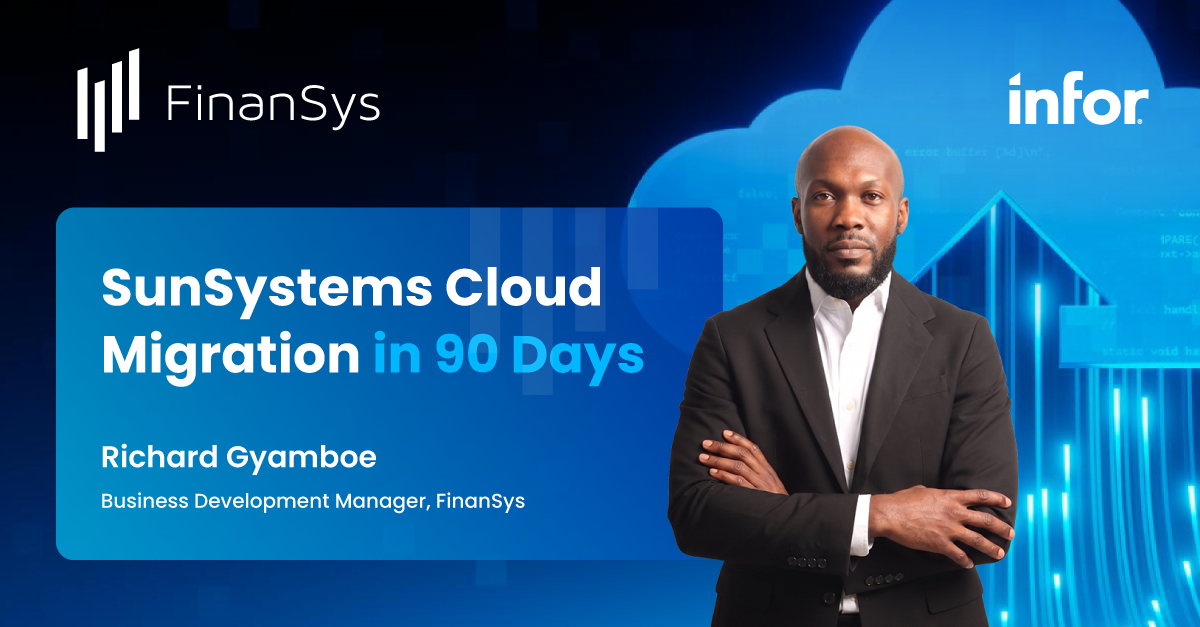
Richard Gyamboe, a SunSystems Cloud specialist with extensive experience in enterprise ERP and FMS migration across multiple platforms and industries, shares his opinion:
“I’ve worked on a number of migration projects, not just SunSystems, but also large-scale transitions on other platforms. And one thing I’ve seen consistently is this: businesses don’t delay because migration is actually slow. They delay because they think it will be slow.
There’s a huge perceived fear of disruption. Organisations assume that migrating to the cloud will take months of downtime, that their operations will be interrupted, and that productivity will drop. But in many cases, that’s not the reality; it’s just the assumption.
Then there’s the mindset of ‘our current system works anyway. It’s legacy, yes, but it’s functioning.’ So there’s no urgency. And that lack of urgency turns into resistance to change.
Add to that the perception of cost. People assume that if something takes a long time, it must be expensive. So now you have the fear of disruption, comfort with the status quo, and fear of cost—all based on assumptions rather than facts. That’s what really delays migration decisions.”
What’s striking here is not the technical complexity; it’s the psychology.
Delay, in other words, is rarely about systems. It’s about perception.
But as Richard explains, the consequences of that hesitation are far more tangible than the fears themselves.
“If you don’t migrate now, there is a cost. And it’s a real one, not perceived.
You continue to pay for infrastructure maintenance, for maintaining the legacy systems, for ongoing on-site support. It might seem small month by month, but over three to five years, you could be spending multiple times more than the cost of having your systems in the cloud
Then there’s security and compliance exposure. If your systems aren’t up to date, you’re more vulnerable. And that’s not just a technical issue; it can become a financial and reputational one. Downtime, data loss, even legal consequences.
And beyond that, you’re limiting your business. Without cloud capabilities, you’re not leveraging real-time insights, automation, or modern integrations. Your decision-making slows down. Your productivity drops. You might still be profitable, but you’re nowhere near optimal.
So the real question isn’t ‘what does migration cost?’ It’s ‘what does not migrating cost?’”
This is where the narrative flips.
For years, speed was framed as the risk: rush the project, and things might break.
But in reality, dragging it out introduces more exposure: more cost, more downtime, more uncertainty.
Still, one objection remains: even if migration should happen, can it really happen in 90 days?
Richard argues that the answer has less to do with the customer and more to do with the partner.
“Projects don’t delay simply because they’re complex. Complexity exists in every migration and it’s normal.
Sometimes, what really determines speed is the partner’s internal capability. Their experience, methodology, and structure.
At FinanSys, for example, there’s a proven track record. Around 80% of migrations are completed within 90 days. That doesn’t happen by chance. It comes from our highly efficient internal processes, deep SunSystems expertise, and a team that understands the system inside out.
When a partner has a working internal arrangement and understand a system deeply, you don’t waste time figuring things out during the project. You already know what works. You apply proven methodologies, adjust where necessary, and move forward efficiently.
If you work with a partner without that experience, you’re effectively part of their learning curve. And that’s where delays happen.”
In other words, speed isn’t about cutting corners. It’s about eliminating uncertainty.
And that’s where structure becomes critical.
“Another key factor is having a structured fast-track programme. Not just a general approach, but a clearly defined framework, from assessment to execution.
There needs to be a blueprint: where we start, what happens at each stage, what comes next. That removes ambiguity and keeps everything aligned.
Transparency is also essential. From day one, there should be honest conversations about requirements, timelines, and expectations. That clarity is what allows projects to move quickly and accurately.
And finally, collaboration. When the client and partner work together effectively, the process becomes much smoother. Regardless of data size or complexity, a well-structured and collaborative approach keeps the project on track.”
So if speed is achievable, what does it actually deliver?
Not in theory, but during the project itself.
“Speed isn’t just about finishing quickly; it’s about reducing risk while you’re migrating.
The faster you complete the migration, the less you spend. Fewer days mean lower project costs. It also means less downtime and less strain on your internal teams. Your people aren’t tied up in months of meetings and project work. They get back to their roles sooner.
There’s also a security aspect. The longer a migration takes, the more exposure you have while data is being moved. A faster, well-structured migration reduces that window of risk.
So speed saves cost immediately, reduces operational disruption, and lowers risk during the transition. Speed is not just a benefit; it’s a necessity.”
Which brings us back to the original question.
Is a 90-day SunSystems Cloud migration possible?
Technically, yes. Practically, also yes; if the right conditions are in place.
But perhaps the more important question is the one Richard leaves hanging:
“If a business says they’ll wait another year, I’d ask three things.
Why are you waiting?
Are you fully aware of the risks of delaying?
And what can be done to remove the concerns stopping you from moving now?Because once those questions are answered honestly, most delays stop making sense.”
Speed, it turns out, is no longer the gamble.
Delay is.