ESG has been moving firmly out of the voluntary lane. For oil, gas and energy companies, environmental, social and governance reporting is now tied to how you access capital, satisfy regulators and answer to boards. If your organisation is still trying to run ESG on spreadsheets, it is time to change.
What ESG Actually Covers for Energy Companies
ESG stands for environmental, social and governance. In most industries, those categories are relatively manageable. In oil, gas and energy, they carry a lot more weight.



The Regulations Worth Knowing
Between 2022 and 2026, the regulatory picture tightened considerably. Here is a practical summary of what applies:
| Framework | What it means in practice |
|---|---|
| TCFD / IFRS S2 | Climate-related financial disclosures: governance, strategy, risk and metrics. Now embedded in ISSB standards. Mandatory for many UK-listed companies. |
| CSRD / ESRS | The EU's Corporate Sustainability Reporting Directive requires double materiality reporting. Applies to large EU entities and groups with EU exposure. |
| SECR | UK Streamlined Energy and Carbon Reporting — applies to many large UK companies since 2019. |
| GHG Protocol | The standard methodology for classifying Scope 1, 2 and 3 emissions. |
| ISSB / IFRS S1–S2 | The emerging global baseline for sustainability disclosures. Increasingly referenced by investors and lenders. |
| GRI | Still widely used for stakeholder-facing sustainability reports. |
An energy group with operations across multiple jurisdictions may need to satisfy several of these at once: the ISSB for capital markets, the CSRD for EU subsidiaries, the GRI for stakeholders, and local rules on top. Building a separate spreadsheet for each framework is not sustainable. The better answer is one internal data model mapped to multiple outputs.
Why ESG Scores Matter Commercially
ESG scores are how external investors, lenders and rating agencies assess how well you manage sustainability risk. For energy companies, the most impactful factors are typically emissions intensity, credible transition plans, safety performance, transparency and governance quality.
The numbers behind ESG investing are significant. Funds managing over $40 trillion now integrate ESG factors into decisions. Better ESG scores tend to correlate with lower financing costs, improved access to capital and stronger relationships with institutional investors.
That said, a higher score is not the goal in itself. The goal is consistent and audit-ready data. Investors and rating agencies will have more reasons to trust you.
Where the Data Challenge Usually Lives
For a mid-sized or large operator, ESG data is rarely missing – it is scattered. Emissions figures may be in field logs, metering systems, HSE tools and contractor reports. Social data sits in HR, procurement and community relations platforms. Carbon costs and environmental provisions live in finance, often disconnected from the operational data they should relate to.
Take a North Sea operator with multiple FPSOs and onshore terminals. To produce a credible ESG report, they need Scope 1 emissions by asset, flaring volumes versus targets, carbon costs allocated to production units, and a clear audit trail for assurance. Without a controlled data model, it becomes a significant manual exercise.
The hardest part is not the data collection. It is linking physical activity to financial statements in a way that enables organizations to clearly demonstrate how operational activity translates into financial outcomes.
How SunSystems Supports ESG Reporting
SunSystems is built around multi-currency, multi-company, multi-ledger accounting, which makes it a practical backbone for organisations managing complex international ESG reporting.
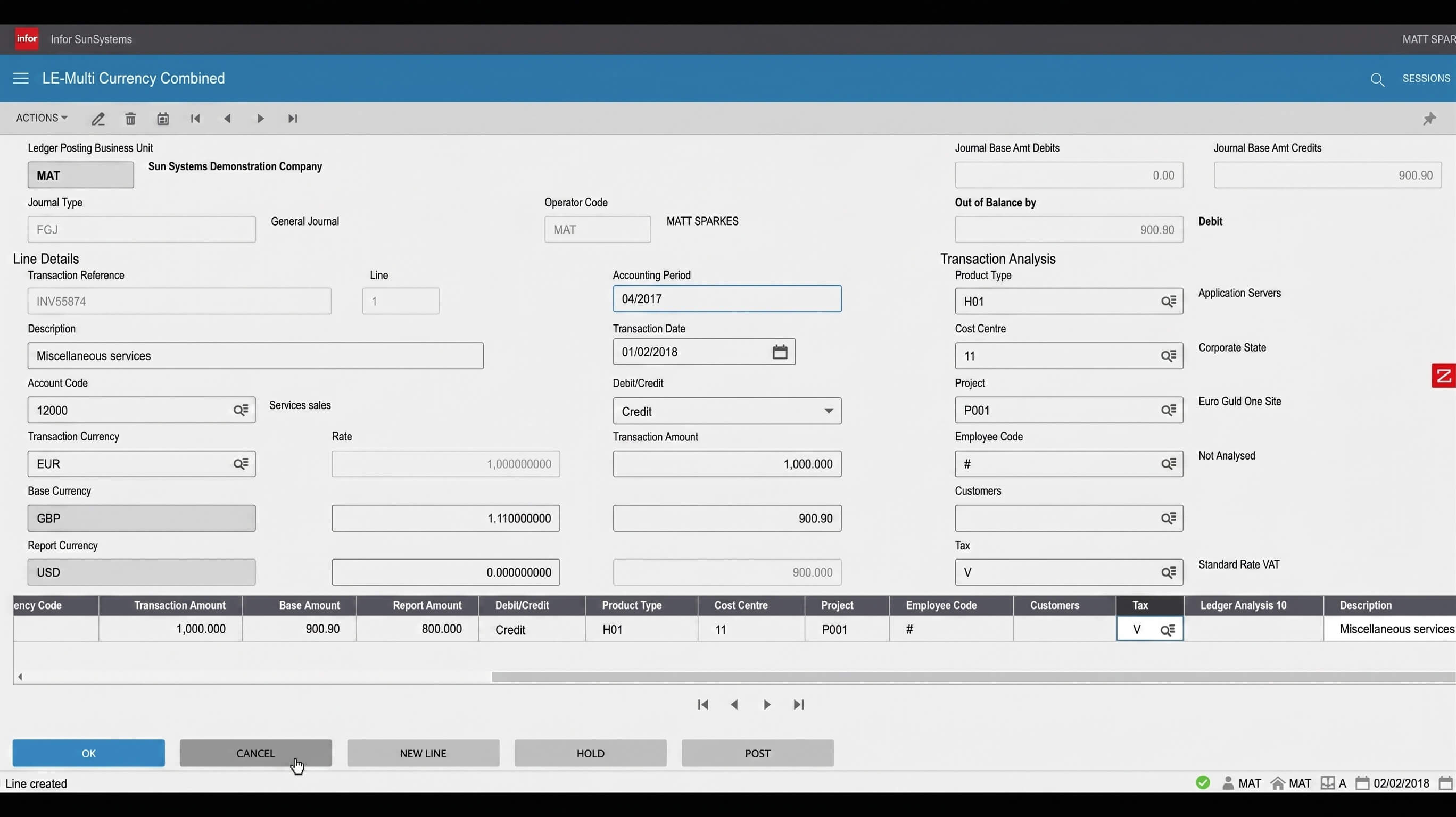
The main areas where it helps:
Chart of accounts and analysis dimensions
Carbon costs, environmental provisions, remediation spend, compliance costs, community investment and governance-related expenditure can all be structured properly from the start.
Statistical accounts
SunSystems can store non-financial ESG data alongside financial data – tonnes of CO₂e, barrels produced, kWh generated, training hours, safety incidents. This makes it possible to calculate emissions intensity per barrel or per MWh directly from the system, rather than building the calculation in a spreadsheet afterwards.
Integration
Finance teams should not be rekeying data from HSE, HR, procurement and operations systems. SunSystems can be configured to receive summarised data from specialist tools directly, limiting the window for human error.
Reporting
A consolidated emissions figure is useful. Knowing which asset, project or supplier is driving the variance is more useful. SunSystems reporting lets users move from group-level numbers to the underlying detail, helping organizations trace reported figures back to the operational activity that drives them.
Working with FinanSys to Set It Up
FinanSys brings implementation experience across international SunSystems environments, including energy sector clients, which means the configuration work is grounded in what actually works in practice.
Common Questions
How is ESG reporting different for oil and gas compared to other sectors?
The exposure is greater. Higher Scope 1 emissions, material Scope 3 from the use of sold products, decommissioning liabilities, and climate transition risk all have direct financial statement implications. Integrated financial and ESG reporting is not a nice-to-have for energy companies.
Can SunSystems handle non-financial ESG data?
Yes, through statistical accounts, analysis dimensions and integrations. SunSystems consumes summarised data and creates a clear connection between operational metrics and financial reporting.
How long does implementation take?
For a mid-sized energy company, a focused first wave of ESG reporting capability is typically achievable within a few months.
Will ESG changes disrupt existing finance processes?
Not if the design is right. A lot depends on your current system or, in cases of platform changes, on who will be implementing it.
Where to Start
The next step is an honest look at where ESG data currently lives, which disclosure obligations apply, and what a controlled reporting structure would need to look like.