

Mandatory e-invoicing is no longer on the horizon in Poland. It is here.
Since 1 February 2026, large taxpayers have been required to issue their B2B invoices through KSeF, the National e-Invoicing System, and the obligation extended to almost every other VAT-registered business in Poland on 1 April 2026. One deadline still remains: from 1 January 2027, the grace period ends and invoices issued outside KSeF can attract penalties of up to 100% of the VAT shown on the invoice.
That changes what an ERP system needs to do for a Polish entity. Compliance is no longer a bolt-on; it is part of the invoicing process itself, because under KSeF, an invoice does not legally exist until the government platform has validated it. This guide explains how NetSuite handles the mandate, what its Polish localisation covers beyond e-invoicing, and how it compares with the main alternative most finance teams evaluate.
Key Takeaways
- KSeF is live. Large taxpayers have been in scope since February 2026 and all other VAT-registered businesses since April 2026. Penalties for non-compliance begin on 1 January 2027.
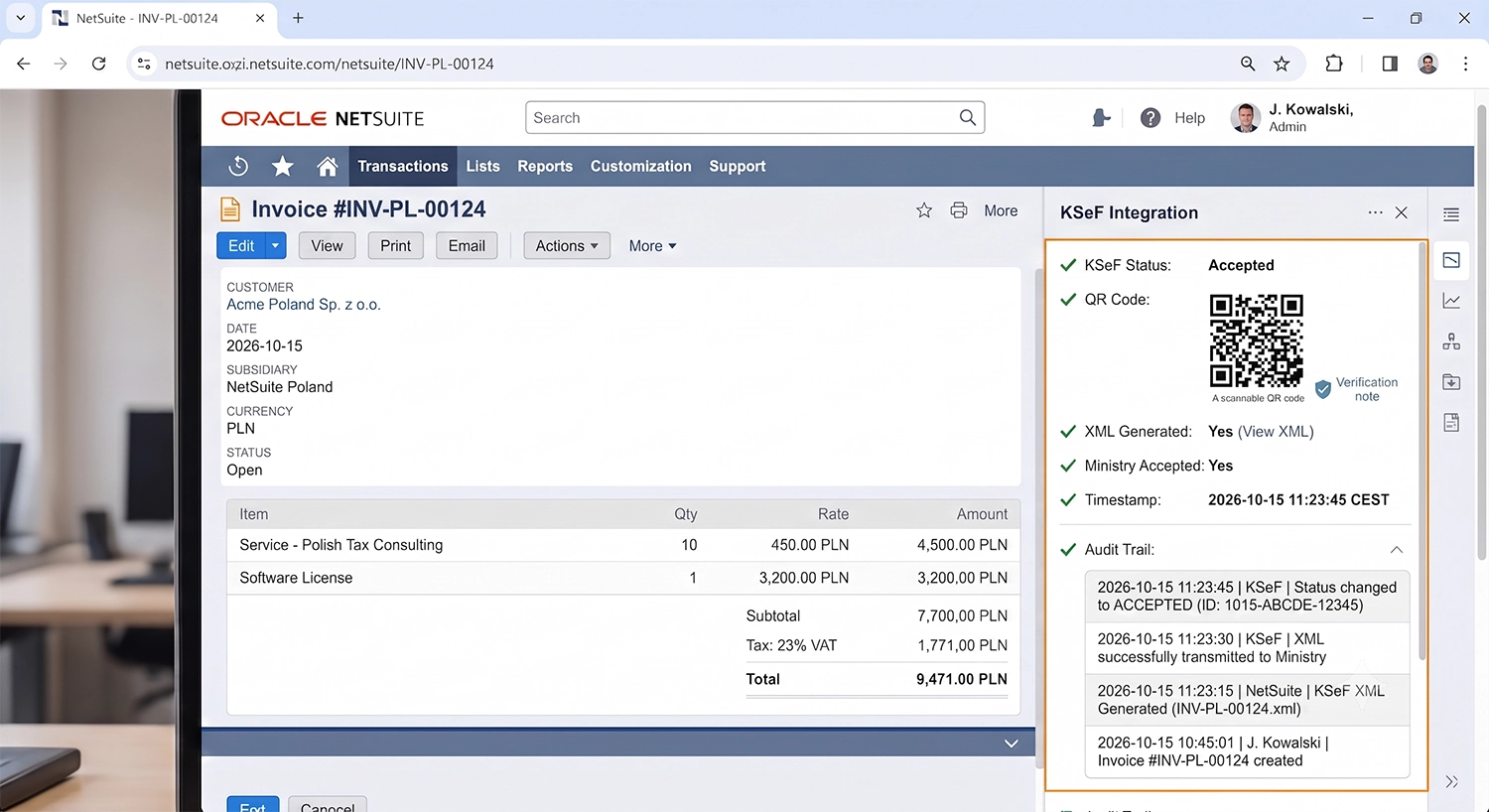
- NetSuite supports KSeF in production. Its Polish localisation creates, receives, and archives structured FA(3) invoices directly through the Ministry of Finance API, so everything stays in one system.
- Localisation goes deeper than e-invoicing. JPK_V7 reporting, split payment, Whitelist vendor checks, NBP exchange rates, and Polish statutory documents are covered as standard.
- One product, not a portfolio. NetSuite covers finance, inventory, full CRM, and ecommerce in a single product on one database. The Microsoft route typically combines Business Central with Dynamics 365 Sales, the Power Platform, and marketplace add-ons; each one comes as an additional licence, integration, and a potential failure point.
- FinanSys implements NetSuite for Polish entities and for international groups with Polish subsidiaries, from discovery workshop through KSeF integration to post-go-live support.
What Is KSeF and Who Does It Affect?
KSeF (Krajowy System e-Faktur) is Poland’s national e-invoicing platform, operated by the Ministry of Finance. It works on a clearance model: every B2B invoice must be submitted as a structured XML file in the FA(3) schema, validated by the platform, and assigned an official KSeF number before it carries legal force. A rejected invoice is treated as never issued. Accepted invoices are stored centrally for ten years, and Polish buyers collect their purchase invoices from the platform rather than receiving a PDF by email.
The rollout has been done in three phases. Businesses with 2024 turnover above PLN 200 million have been required to issue through KSeF since 1 February 2026. All other VAT-registered businesses, including VAT-exempt entities, followed on 1 April 2026. The smallest businesses, those issuing invoices up to PLN 450 or with monthly sales up to PLN 10,000, join on 1 January 2027.
Throughout 2026 the Ministry of Finance is applying a grace period: no financial penalties for KSeF errors such as late submission or incorrect formatting. That runway closes on 31 December 2026. From 1 January 2027, issuing an invoice outside KSeF when the mandate applies can cost up to 100% of the VAT amount on that invoice, or 18.7% of the gross amount where no VAT is shown. Cash register invoicing outside KSeF also ends at the same point. In practice, the second half of 2026 is the last safe window to implement and test.
The mandate reaches further than many international groups expect. A foreign company with a fixed establishment in Poland is subject to the same requirements as a Polish business. Export and intra-EU invoices issued by Polish VAT-registered sellers must also pass through KSeF, even at a zero VAT rate; the foreign customer simply receives a copy carrying the KSeF reference and verification code.
Where NetSuite Fits In
NetSuite is a cloud ERP platform owned by Oracle and used by 40,000+ organisations worldwide. It manages finance, order-to-cash, procure-to-pay, inventory, projects, CRM, and e-commerce in a single system built on one database, which means every department works from the same live data rather than last week’s export. It is delivered entirely as software as a service: no on-premise servers, no customer-managed patches, and two automatic platform upgrades a year handled by Oracle.
For Poland specifically, NetSuite is available with a certified localisation package that has been maintained by local partners for years and is updated as Polish regulations change. That combination, a global platform plus a maintained local compliance layer, is what makes it a realistic option both for mid-sized Polish companies and for international groups consolidating a Polish subsidiary.
How NetSuite Handles KSeF
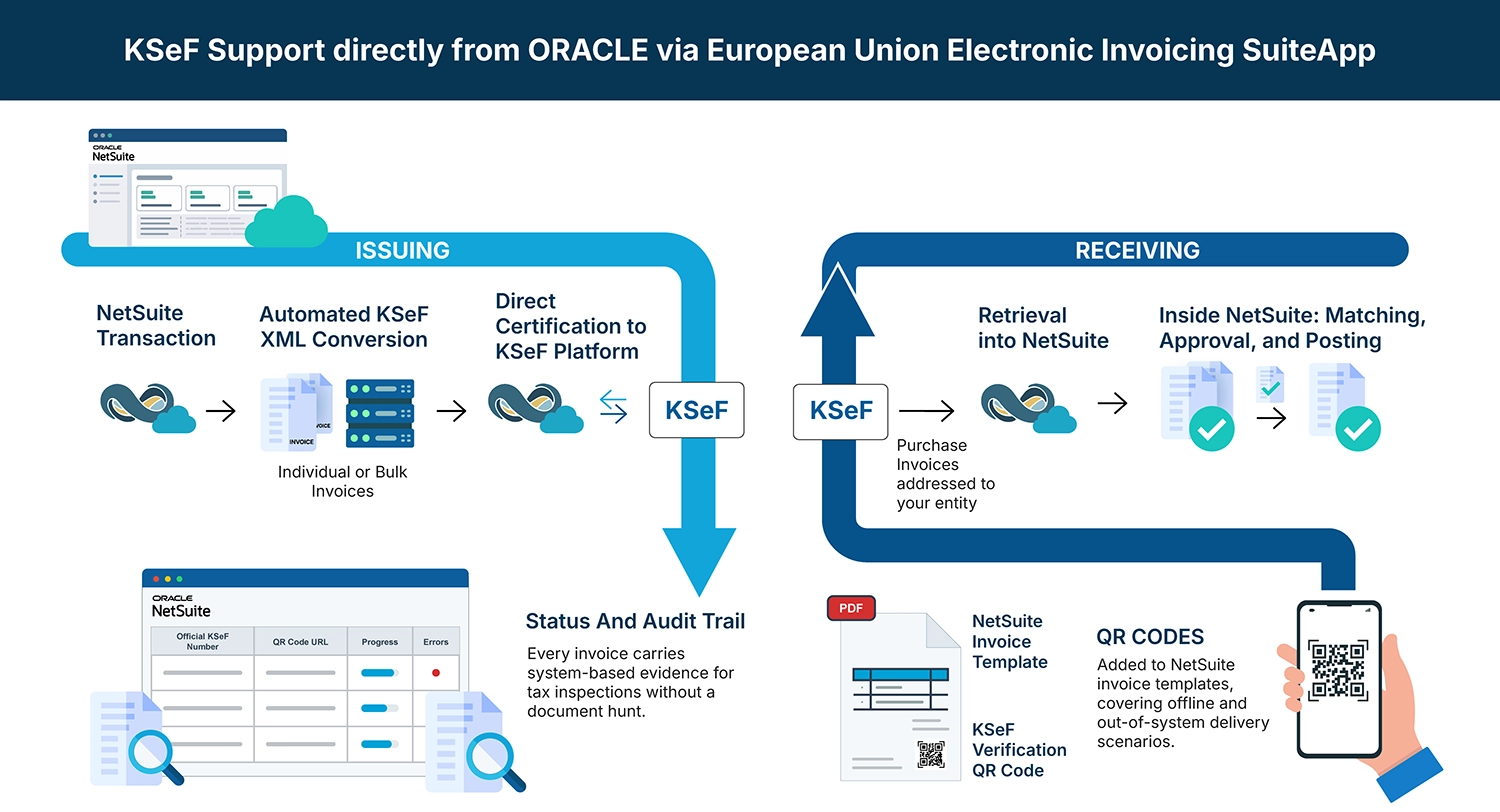
KSeF support in NetSuite comes from Oracle directly, through the European Union Electronic Invoicing SuiteApp, so structured e-invoicing is part of the billing workflow rather than a separate tool. In day-to-day use, that looks like this:
- Issuing: invoices and credit memos are converted to the KSeF XML schema and certified to the platform directly from the transaction in NetSuite — individually or in bulk — with no re-keying into a government portal.
- Receiving: purchase invoices addressed to your entity are retrieved from KSeF and matched inside NetSuite, ready for approval and posting.
- Status and audit trail: after certification, the official KSeF number and QR code URL are stored on the transaction, with progress and errors visible in the e-document status and audit trail. Every invoice carries system-based evidence for tax inspections without a document hunt.
- QR codes : the KSeF verification QR code required on paper or PDF visualisations of e-invoices can be added to NetSuite invoice templates, covering offline and out-of-system delivery scenarios.
Because validation happens before an invoice legally exists, data quality matters more under KSeF than it ever did with PDF invoicing; and the failure modes are specific. Generation fails if a tax code is not mapped to a Polish tax category, or if a required PLN exchange rate is missing on a non-PLN transaction, and the NIP must be set correctly on both the subsidiary and the customer record. An implementation that gets this configuration right prevents most rejections before they happen.
Polish Localisation Beyond KSeF
E-invoicing gets the headlines, but most of the daily compliance workload in a Polish finance team sits elsewhere. NetSuite’s Polish localisation package covers that ground as standard:
- VAT and JPK reporting: JPK_V7 files, split payment (mechanizm podzielonej płatności), reverse charge scenarios, and intra-EU transactions.
- Polish accounting standards: chart of accounts templates, statutory ledgers, and reporting layouts aligned with the Accounting Act (Ustawa o rachunkowości).
- Local documents and language: Polish-language interface, local date and number formats, and document types such as WZ, PZ, advance invoices, and corrections.
- NBP exchange rates: daily average rates from the National Bank of Poland retrieved automatically for VAT, currency postings, and JPK.
- Vendor verification: Whitelist (Biała Lista) bank account checks, VAT payer status, and VIES and GUS register lookups run automatically when you onboard a vendor or process a payment.
The localisation is maintained as regulations change, which matters in a jurisdiction where they change often. Your compliance layer stays current without emergency custom development.
NetSuite vs Microsoft Dynamics in Poland
Both platforms serve real needs, but if you are comparing the two for a Polish entity, three structural differences tend to decide it.
One platform versus an ecosystem. NetSuite delivers finance, inventory, CRM, and e-commerce on a single unified platform. Microsoft splits functionality across Business Central, Finance & Operations, the Power Platform, and a marketplace of add-ons. Each additional component is another integration to build, licence, and maintain.
Upgrades. NetSuite upgrades are automatic and consistent for every customer, twice a year. Dynamics environments, particularly heavily customised ones, often require project work at major version changes, which carries cost and risk that rarely appears in the initial comparison spreadsheet.
KSeF and localisation model. Both platforms handle Polish compliance through maintained localisation layers, so evaluate the specific package rather than the brand. The difference is who stands behind the e-invoicing layer: NetSuite’s KSeF support ships from Oracle itself through the European Union Electronic Invoicing SuiteApp, while Business Central’s Polish localisation and KSeF features come from partner-built extensions.
For mid-market companies and multi-entity groups that want one global platform with dependable Polish compliance, NetSuite is usually the simpler and lower-risk choice. Where a business is deeply committed to the Microsoft stack and has the internal capability to manage a multi-product environment, Dynamics remains a credible alternative.
How Much Does NetSuite Cost in Poland?
The honest answer is that it depends on scope, and any partner who quotes a fixed price before understanding your business is guessing. NetSuite is licensed on a subscription basis, sized by modules and user count, with no perpetual licences and no surprise upgrade fees. Total cost of ownership has five main components: subscription licences, implementation services, data migration, integrations, and training.
What the cloud model removes is equally important: servers, database licences, backup infrastructure, and the upgrade project every five to ten years that on-premise systems eventually force. A meaningful estimate for a Polish deployment takes a short discovery session, which FinanSys provides free of charge together with a personalised demo and a written proposal.
How Long Does a NetSuite Implementation Take?
A focused, financials-first project covering core accounting, VAT, JPK, and KSeF integration typically takes three to six months. Multi-module and multi-subsidiary rollouts that add order management, inventory, procurement, and CRM usually run six to twelve months. The factors that can stretch timelines are predictable: complex legacy integrations, poor data quality, heavily customised business processes, and multi-country scope.
Projects follow a structured path: discovery and design, configuration, localisation including KSeF, data migration, user training, go-live, and a hypercare period. FinanSys runs implementations on a milestone basis with parallel runs and structured testing before any legacy system is switched off, so go-live is controlled rather than chaotic.
Preparing for the January 2027 Enforcement Deadline
If your Polish entity is already in scope, you are invoicing through KSeF today, penalty-free, while the grace period lasts. That makes the remainder of 2026 an implementation runway rather than a waiting room. Four steps matter most:
- Audit your current process. Map how invoices are issued and received now, and where manual steps or workarounds have crept in since April.
- Clean master data. NIP numbers, addresses, VAT settings, and tax codes must be accurate before automation can work. Bad data is the leading cause of KSeF rejections.
- Test at volume. Run representative invoice types, including corrections and advance invoices, through the integration before penalties apply.
- Train the team. AR and accounting staff need to know the exception workflow: what a rejection code means, who resolves it, and how reconciliation works when every invoice is government-validated.
Companies that treat 2026 as a test year gain operational stability before enforcement begins. Companies that wait until December will be debugging their invoicing process with penalty exposure attached.
How FinanSys Supports NetSuite in Poland
FinanSys is a specialist NetSuite partner delivering end-to-end implementations, with 27 years of ERP experience and a 94% retention rate.

The team works with Polish companies directly and with international teams that run Polish subsidiaries, which is often where compliance questions are hardest: group reporting standards on one side, KSeF, JPK, and the Accounting Act on the other. If you want to see how NetSuite could handle your specific processes, FinanSys offers a free, no-obligation demo tailored to your industry, entity structure, and regulatory priorities. Bring your current pain points and a sample invoice flow, and the session will focus on real scenarios rather than generic features.
Frequently Asked Questions
Is NetSuite compliant with mandatory KSeF e-invoicing in Poland?
Yes. Oracle’s European Union Electronic Invoicing SuiteApp provides KSeF support in NetSuite directly: invoices and credit memos are generated in the required XML schema, certified to KSeF from the transaction, and the official KSeF number, QR code, status, and audit trail are stored on the record. No separate e-invoicing tool is required.
What is the deadline for KSeF compliance?
KSeF is already mandatory for most businesses: since 1 February 2026 for large taxpayers and since 1 April 2026 for other VAT-registered businesses. The smallest businesses join on 1 January 2027, which is also the date financial penalties take effect for everyone. Until then, a grace period applies and no penalties are imposed for KSeF errors.
What are the penalties for not using KSeF?
From 1 January 2027, issuing an invoice outside KSeF when the mandate applies can result in a penalty of up to 100% of the VAT amount on the invoice, or up to 18.7% of the gross amount where no VAT is shown. Invoices without a valid KSeF number are also invalid for tax purposes, which affects the buyer’s VAT deduction.
Can NetSuite run Polish and international entities in one system?
Yes. NetSuite OneWorld supports multi-company, multi-currency, and multi-language operation in a single instance. Group reporting and consolidation run centrally while each Polish entity keeps its own statutory ledgers, VAT registers, and KSeF credentials.
Does a foreign company with a Polish subsidiary need to use KSeF?
If the entity has a registered office or fixed establishment in Poland, yes, it falls under the mandate in the same way as a domestic business. Export and intra-EU invoices issued by a Polish VAT-registered entity must also go through KSeF; the foreign customer receives a copy carrying the KSeF reference and verification code.
How long does it take to implement NetSuite with KSeF integration?
A financials-first implementation covering accounting, VAT, JPK, and KSeF typically takes three to six months. Broader rollouts with inventory, procurement, and CRM usually take six to twelve months, depending on data quality and integration complexity.

